

Strength of Materials
Strength of Materials is a foundational engineering course that deals with the behavior of engineering materials under load, stress, strain, axial loading, riveted connections, torsion, bending, transverse shear in beams and combined stress.
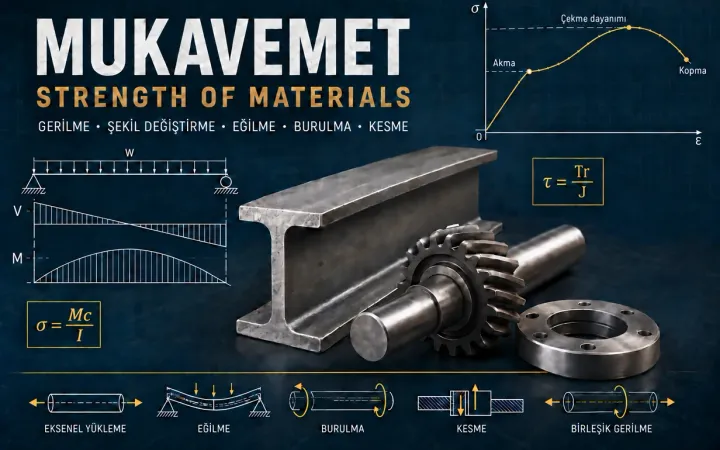
Course Content
ChaptersThe place of strength in engineering is discussed through the transition from rigid-body idealization to the deformable-body approach. External load, internal force, sectioning method, equilibrium equations and behavior of structural members under load are introduced. The central questions in strength-of-materials problems are framed in terms of stress, deformation, safe carrying capacity and design interpretation.
The basic mechanical behavior of engineering materials is examined through the stress-strain relationship. The concepts of normal stress, shear stress, normal strain, shear strain, elastic zone, plastic zone, yielding, rupture and factor of safety are discussed. Hooke's law, modulus of elasticity, shear modulus and Poisson's ratio are studied through basic worked examples and problem solving.
Normal stress, elongation, shortening and stiffness calculations are examined in rods subjected to axial load. Deformation compatibility and equilibrium equations are used together in elements with different cross-sectional areas and different materials. Single shear, double shear, bearing stress and tensile stress in rivets, pins, bolts and simple fasteners are handled by worked examples and problem solving.
The concepts of elongation-shortening and thermal stress caused by temperature change are examined. Deformation compatibility is considered in systems where free expansion, constrained expansion and different materials are used together. Statically indeterminate axial loading problems are solved by using balance, material relation and compatibility equations together.
Shear stress and angle of rotation occurring under torsional moment in circular shafts are examined. The torsion formula is derived. The linear change of shear stress along the section radius and the occurrence of maximum shear stress on the outer surface are interpreted physically. Polar moment of inertia, angle of rotation, shafts connected in series, shafts of different diameters and material effects are studied through worked examples and problem solving.
Torsion problems are addressed through power transmission and rotating machine elements. The power carried on the shaft, angular speed, torque relationship and safe shaft diameter calculation are examined. Torque diagrams, shear stress and angle of rotation calculations are studied through worked examples and problem solving in gear systems, pulleys and shafts to which torque is applied from different points.
Normal stress distribution in beams under pure bending is examined. The bending formula, neutral axis, curvature, elastic bending behavior, and the effect of section geometry on stress are discussed. Maximum tensile and compressive stresses are calculated by worked examples and problem solving using the area moment of inertia in rectangular, circular, I, T and compound sections.
The shear stress distribution caused by shear force in the beams is examined. Using the shear formula, first area moment, section width and area moment of inertia, it is interpreted how the shear stress changes along the section. Shear stress distribution in rectangular, circular and thin-walled sections. It is discussed with worked examples and problem solving along with an introduction to the concept of cutting center.
In beams, normal force, shear force and bending moment diagrams are connected to the strength calculation. Drawing of N–T–M diagrams under point load, distributed load and moment load is repeated and how to determine critical sections is explained. Determination of maximum normal stress and maximum shear stress regions from bending moment and shear force diagrams is studied through worked examples and problem solving.
Combined stress analysis is performed in systems where axial load, bending moment, shear force and torsional moment exist together. The total stress state is interpreted by calculating the normal and shear stresses occurring in the same section separately. In simple shaft, beam, connection and machine element problems, tension/compression, bending and torsion effects are evaluated together.
For the interpretation of combined stress states, the concept of principal stress transformation is introduced. Principal stresses, maximum shear stress, and the basic use of Mohr's circle are covered to a limited extent. The aim of this section is to evaluate complex stress situations in terms of engineering design and factor of safety without going into advanced theory.
Targeted Learning Outcomes
- Interpret the behavior of engineering materials under load with the concepts of stress and strain.
- Use normal stress, shear stress, strain, Poisson's ratio and Hooke's law in basic strength problems.
- Calculate elongation, shortening, stress and deformation in rods under axial loading.
- Ability to analyze shear, crushing and tensile stresses in rivets, pins, bolts and simple fasteners
- Solve torsional moment, shear stress, rotation angle and power transfer problems in circular shafts
- Interpret normal stress and shear stress distributions in beams under pure bending and transverse shear in beams.
- Perform principal stress analysis by evaluating axial, bending and torsion effects together in combined loading situations.