

Physics I
Physics I support. It offers a concept-based and problem-solving focused academic study process on vectors, kinematics, Newton's laws, work-energy, momentum, rotational motion, gravitation and harmonic motion.
Course Content
ChaptersSeparating vectors into their components in space, vector addition-subtraction, expressing vectors with unit vectors, scalar multiplication and vector multiplication concepts are discussed.
Movement in one, two and three dimensions. It is examined through the concepts of position, displacement, speed and acceleration. Establishing equations of motion and selecting the appropriate coordinate system are studied in constant acceleration motion, vertical throw, oblique throw and relative motion problems. Emphasis is placed on obtaining velocity and position expressions using the differential equation approach in movements with variable acceleration, interpreting motion graphs, and correctly reading the physical meaning.
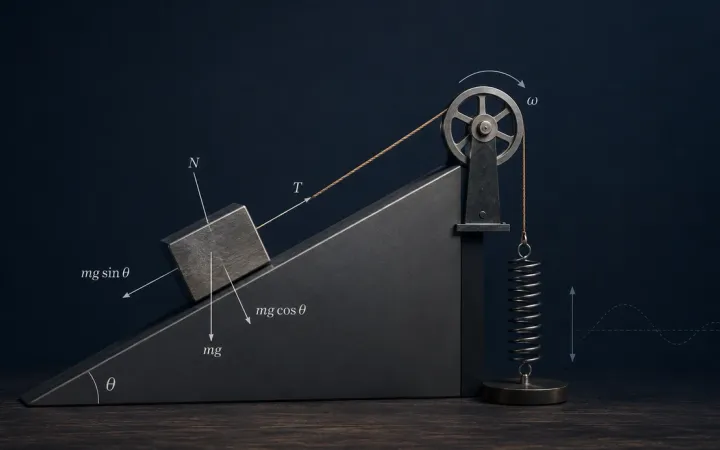
Newton's laws of motion, free body diagram and force-acceleration relationship are discussed through worked examples and problem solving. The ability to establish systematic equations and make physical interpretations is developed through the applications of friction force, inclined plane, connected objects, rope tension, normal force and circular motion.
The concept of work, the component of force in the direction of displacement and work calculation under variable force are examined. The physical basis of the kinetic energy expression is explained using the work–energy theorem, and the relationship between net work and kinetic energy change is addressed through worked examples and problem solving. Work calculation from the force-position graph, sign convention and the advantages of the energy approach in worked examples and problem solving are emphasized.
Conservative forces, potential energy, mechanical energy and the principle of conservation of energy are discussed. Establishment of energy equations and initial-final state analysis are performed on gravitational potential energy, spring potential energy, frictional and frictionless systems.
The concepts of linear momentum, impulse, momentum change and conservation of momentum are examined. Collisions, explosions, one- and two-dimensional momentum problems, distinction between elastic, inelastic and completely inelastic collisions, and the importance of system selection in worked examples and problem solving are emphasized.
The concepts of angular position, angular velocity, angular acceleration, torque and moment of inertia are discussed. Rotational kinematics, rotational dynamics, rolling motion without slipping, rotational kinetic energy and angular momentum problems of solid bodies rotating around a fixed axis are studied.
Newton's law of universal gravitation, gravitational field, gravitational potential energy and orbital motion are examined. The gravitational potential energy expression is interpreted by deriving it from the work done against the gravitational force and the selection of the reference point. Basic principles of planetary motion, Kepler's laws, circular orbit approach, escape velocity and satellite motion problems are addressed using Newton's laws and mechanical energy approach.
The mathematical model of simple harmonic motion is examined through the spring-mass system and the simple pendulum. The physical meaning of period, frequency, angular frequency, amplitude, phase, energy conversion and equations of motion are studied together with the problem solution.
Targeted Learning Outcomes
- To strengthen the physical meaning of basic concepts in Physics I / Mechanics subjects
- To develop systematic worked examples and problem solving skills on vectors, kinematics, Newton's laws, work-energy and momentum.
- Gaining the habit of constructing a free-body diagram, choosing the appropriate coordinate system and creating the correct set of equations.
- Applying mechanical principles correctly in rotational motion, gravity and harmonic motion problems
- Ability to solve problems with physical modeling and interpretation rather than memorizing formulas