

Partial Differential Equations (PDE)
Partial Differential Equations (PDE) is a graduate-level mathematics course that deals with boundary and initial value problems, Sturm–Liouville theory, orthogonal functions, Fourier series, transformation methods and analytical solution approaches of classical heat, wave, Laplace and Poisson equations.
Course Content
ChaptersThe ordinary differential equation infrastructure required for partial differential equations is repeated. Linear ODEs, initial value problems, boundary value problems, homogeneous and non-homogeneous boundary conditions are discussed. In this section, the connection of eigenvalue problems arising in PDE solutions with ODE boundary value problems is established.
Sturm–Liouville problems are examined through the concepts of eigenvalue, eigenfunction, weight function and orthogonality. Under homogeneous boundary conditions, eigenfunctions form orthogonal basis and the general solution is expressed with eigenfunction series. This section forms the mathematical basis of PDE problems solved by separation of variables.
Fourier series are considered as the basic example of orthogonal function expansions. Sine, cosine and full range Fourier series; odd–even functions, half-range expansions and convergence behavior are examined. The effect of boundary conditions on the selection of the appropriate Fourier expansion and the physical meaning of Fourier coefficients are studied through worked examples and problem solving.
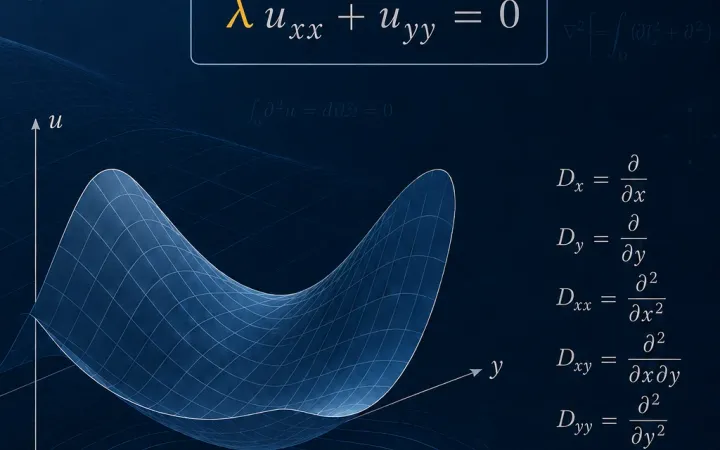
PDE concept. The field variable is introduced through the independent variables, order, linearity and homogeneity. In second order linear PDEs, elliptic, parabolic and hyperbolic classification is made. The relationship of Laplace/Poisson, heat and wave equations with these classes is interpreted through physical examples.
First-order partial differential equations are examined with the characteristic curves approach. Establishment of characteristic equations in quasi-linear and linear first order PDEs, initial curve and solution surface concepts are discussed. The physical meaning of the characteristic method is demonstrated through the transport equation and simple wave propagation problems.
The heat equation, parabolic PDE structure and diffusion are discussed through physical interpretation. In one-dimensional heat conduction problems, initial condition and boundary conditions are established. In homogeneous Dirichlet, Neumann and mixed boundary conditions, the method of separation of variables is applied. The temperature field is obtained by Fourier series and eigenfunction expansions.
Problems involving inhomogeneous boundary conditions, internal heat production or a source term in the heat equation are considered. Separation of the solution into steady and transient parts, homogenization of boundary conditions and superposition approach are studied. In this section, it is shown through worked examples and problem solving how physical boundary conditions change the mathematical solution strategy.
The wave equation, hyperbolic PDE structure and vibration/wave propagation are examined through its physical interpretation. The solution is established using wire vibration, initial displacement, initial velocity and boundary conditions. The method of separation of variables, normal modes, eigenfrequencies and d'Alembert solution are discussed at a basic level.
Laplace and Poisson equations are examined within the elliptic PDE class. Connections are made to physical examples such as potential problems, steady heat conduction, electrostatic potential, and flow potential. The method of separation of variables in rectangular regions, the application of boundary conditions and the physical interpretation of harmonic functions are studied through worked examples and problem solving.
Fourier and Laplace transforms are considered as analytical methods used to solve PDE problems in infinite or semi-infinite regions. The transformation of the space variable with the Fourier transform and the transformation of the time variable with the Laplace transform is examined. In heat, wave and diffusion type problems, the solution strategy is studied using the transformation method.
Special functions that appear in cylindrical and spherical coordinates are introduced. The effects of Bessel's equation, Legendre's equation, roots, orthogonality and boundary conditions on special function solutions are examined at a basic level. Connections are made to circular membrane, cylindrical heat conduction and spherical potential problems.
Green's function approach is discussed through the general solution idea for linear differential operators and source term problems. Impulse response, delta function, boundary conditions and superposition concepts are examined. In this section, the role of Green's functions in Poisson, heat and wave problems is interpreted at a basic level.
Targeted Learning Outcomes
- Correctly define independent variables, field variables, initial conditions and boundary conditions in PDE problems.
- Classify first- and second-order PDEs in terms of their physical meanings and mathematical types.
- Use eigenvalue, eigenfunction, orthogonality and series expansion logic in Sturm–Liouville problems.
- Solving boundary and initial value problems with the help of Fourier series, Fourier transform and Laplace transform
- Solve heat, wave, Laplace and Poisson equations by separating their variables.
- Interpret the effect of homogeneous and non-homogeneous boundary conditions on the solution structure physically and mathematically.
- Apply more general PDE solution approaches at a basic level with Green's function, special functions and eigenfunction expansions.