

Numerical Methods
Numerical Methods is a basic engineering mathematics course that deals with approximate numerical solutions of engineering problems that are difficult to solve analytically, through error analysis, root finding, systems of linear equations, curve fitting, interpolation, numerical derivative, numerical integral and numerical solution of differential equations.
Course Content
ChaptersThe purpose of numerical methods in engineering problems, their differences with analytical solutions, and approximate solution logic are discussed. The concepts of algorithm, iteration, convergence, stopping criterion and computational process are introduced. Truncation error, rounding error, absolute error, relative error, percentage error, significant digit and error propagation are examined through worked examples and problem solving. This section emphasizes why numerical solution requires method and error control, not just results.
The problem of finding roots in single variable nonlinear equations is addressed. Within the scope of implicit methods, range determination, sign change, intermediate value theorem, bisection method and false position method are examined. Convergence guarantee, number of iterations, error estimation and stopping criteria are studied through worked examples and problem solving through engineering examples.
Within the scope of open root finding methods, fixed-point iteration, Newton-Raphson method, modified Newton-Raphson (Ralston and Rabinowitz), secant method and modified secant method are discussed. Additionally, it is taught how to find the roots of a system of two-variable nonlinear equations using the Neston-Raphson method. The impact of the initial estimate, speed of convergence, probability of divergence, use of derivatives, and multiple root behavior are examined. The advantages of closed and open methods are compared; How to choose the appropriate root finding method in engineering equations is shown through worked examples and problem solving.
Numerical solutions of linear equation systems are examined through direct methods. Gauss elimination, Gauss-Jordan elimination, pivoting, LU decomposition, Cholesky decomposition and Thomas algorithm methods are discussed. The solution advantages of banded and tridiagonal systems, the processing load, the effect of the matrix structure on method selection and their usage areas in engineering applications are studied through worked examples and problem solving.
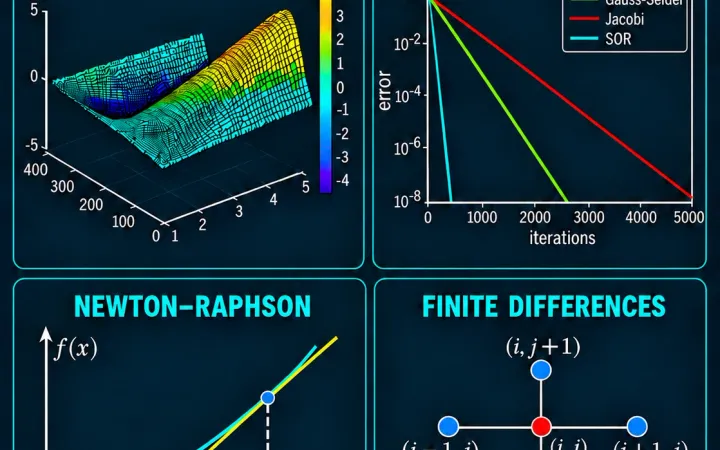
Jacobi, Gauss-Seidel and Gauss-Seidel SOR methods are examined in the iterative solution of systems of linear equations. Convergence criteria, initial estimate, residual, iteration matrix, dominant diagonal and error tracking are discussed. In the GS-SOR method, the effect of the relaxation parameter and the optimum relaxation parameter calculation are studied through worked examples and problem solving. This section highlights why iterative schemes are important in large engineering systems.
Determining the function that best fits the data points is handled by the least squares method. Linear regression equations are obtained by minimizing the sum of squared errors. Polynomial least squares method, normal equations, residual interpretation and appropriate model selection are studied. In this section, how experimental engineering data are transformed into model parameters is examined through worked examples and problem solving.
In nonlinear curve fitting problems, bringing the model into linear form by using appropriate transformations is considered. Exponential, power, logarithmic and rational models. It is examined with variable transformations such as log x, log y, 1/x or similar. Least squares calculation is performed on the transformed data and how to convert the obtained coefficients back to the original physical model is shown with the problem solution.
The interpolation problem is addressed with the aim of estimating values between known data points. The setup of the Lagrange interpolation polynomial, the degree of interpolation, and the effect of the number of selected points on the error and oscillation behavior are examined. Interpolation worked examples and problem solving is carried out using tabular data, experimental measurements and engineering graphics.
Newton interpolation method is examined through the divided difference approach. Divided difference table, stepwise setup of interpolation polynomial, ease of adding new data points and comparison with Lagrange method are discussed. Newton interpolation is used together with engineering applications in equally spaced and non-equally spaced data sets.
Numerical derivative methods are used to calculate derivatives from discrete data points. Forward difference, backward difference, central difference and higher order difference formulas are obtained by the Taylor series approach. Cutting error, step interval selection, the effect of data precision on derivative calculation, and applications of velocity, acceleration, gradient or rate of change calculation in engineering problems are examined.
Numerical integral methods are examined for the purpose of calculating the area and total effect for functions or discrete data sets that are difficult to integrate analytically. Trapezoidal method, Simpson 1/3 method, Simpson 3/8 method and compound integral formulas are discussed. Error behavior, step interval selection and area, volume, work, heat transfer and mean value calculation worked examples and problem solving are studied in engineering applications.
Numerical solutions of ordinary differential equations for initial value problems are discussed. The basic logic of the Euler method, the improved Euler/Heun method, the midpoint method and the Runge-Kutta methods are examined. The fourth-order Runge-Kutta method (RK4) is studied in detail; Numerical acquisition of step interval, local/global error, stability and time-dependent response of engineering systems is applied through worked examples and problem solving.
Targeted Learning Outcomes
- Interpret the difference between analytical and numerical solution approaches
- Relate the concepts of error, convergence, algorithm and iteration in numerical methods to engineering problems.
- Select and apply closed and open root finding methods according to the appropriate problem type.
- Solve systems of linear equations directly and iteratively; To evaluate the differences between the methods in terms of convergence and processing load
- Solve linear, polynomial and transformable nonlinear curve fitting problems using the least squares method.
- Ability to interpolate experimental/data-based engineering problems using Lagrange and Newton interpolation methods.
- Apply numerical derivative and numerical integral methods together with their error behavior.
- Solve differential equations numerically with Euler, improved Euler and Runge-Kutta methods in initial value problems.