

Gas Dynamics / Compressible Aerodynamics
Gas Dynamics / Compressible Aerodynamics is a foundational engineering course that starts from the basics of thermodynamics and covers isentropic flow, speed of sound, Mach waves, normal and oblique shocks, Prandtl–Meyer expansion waves, Laval nozzles, linear compressible flow theory, Fanno flow, Rayleigh flow, shock tube and introduction to hypersonic flow.
Course Content
ChaptersThe thermodynamic background required for introduction to gas dynamics is repeated. The ideal gas equation, specific heats, gas constant, specific heat ratio, enthalpy, internal energy, entropy and total/rest properties are discussed. The concepts of energy equation, adiabatic flow, reversibility, isentropic process, and entropy production in real flows are associated with compressible flow problems.
The thermodynamic basis of the speed of sound, Mach number and compressibility effects are discussed. Subsonic, transonic, supersonic and hypersonic flow regimes are interpreted physically. The continuum approach via the Knudsen number, slip flow, transitional flow and molecular flow regimes are introduced. By deriving isentropic flow relations, classical sum/stall relationships between temperature, pressure, density and Mach number are obtained.
The concept of total enthalpy and the relation h + V²/2 = h₀ are examined through the energy equation in compressible flow. The concepts of small amplitude pressure waves, sound waves, Mach wave, Mach angle and Mach cone are discussed. The propagation of weak disturbances in supersonic flow is explained; Using the piston-cylinder analogy, it is physically depicted that the gas behind the compression waves gains temperature and speed, the following waves catch up with the leading waves with a higher propagation speed, and the continuous compression wave family turns into a shock wave.
Normal shock waves are studied using conservation of mass, momentum, and energy across the discontinuity surface. Rankine–Hugoniot relations are obtained and Mach number, pressure, temperature, density and total pressure changes before/after the normal shock are studied by worked examples and problem solving. The increase in entropy, total pressure loss, irreversibility and the transition of flow from supersonic to subsonic during the shock are interpreted physically.
Oblique shock waves are studied as discontinuities that occur when the flow turns around a compressive corner. The application of normal shock relations to an oblique shock via the velocity component perpendicular to the shock is shown. θ–β–M relationship, weak/strong shock solutions, attached and detached shock distinction, maximum deviation angle and shock polar interpretation are discussed. Problem solving is done using oblique shock tables and charts.
The Prandtl–Meyer expansion fan structure, which occurs when the supersonic flow turns around an expanding corner, is examined. Increasing Mach number, decreasing pressure and temperature, isentropic expansion and Prandtl–Meyer function worked examples and problem solving are studied. Expansion problems are solved by using tables and charts. It is especially emphasized under what conditions an oblique shock and under what conditions an expansion fan will occur if the same flow turns around a corner.
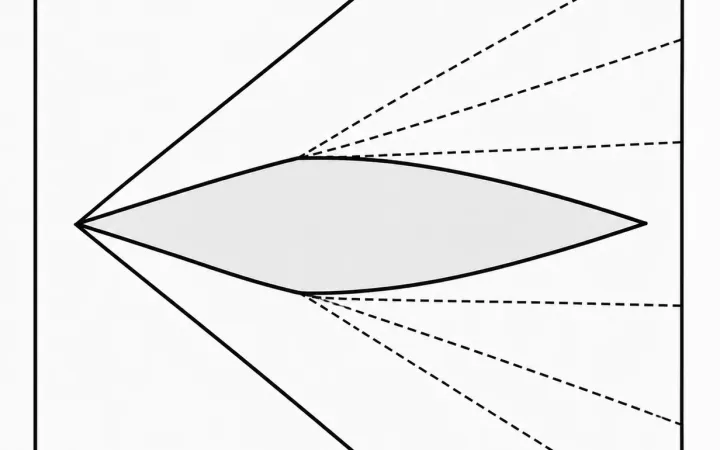
In supersonic flows, compressive and expanding corner turns are considered together. Wedge, nozzle exit and simple supersonic profile problems are solved by using the oblique shock and Prandtl–Meyer expansion fan sequentially. The relationship between the flow direction of rotation, pressure change, Mach number change and wave structure is interpreted physically. In this section, the basic logic of the shock-expansion approach is established.
Area–velocity and area–Mach relationships are derived using the quasi-one-dimensional compressible flow approach. Subsonic and supersonic flow behavior in convergent, divergent and convergent–divergent Laval nozzles is examined. Choking, critical area, critical pressure ratio, mass flow rate, throat conditions and isentropic nozzle relations are obtained mathematically.
Flow regimes that occur due to back pressure changes in Laval nozzles are examined. Completely subsonic flow, choked flow, normal shock in the nozzle, shock at the nozzle exit, underexpanded and overexpanded jet situations are discussed. Normal shock, oblique shock and expansion fan formation at the nozzle exit are interpreted physically. Appropriate flow regime selection in nozzle, diffuser and wind tunnel applications is studied through worked examples and problem solving.
An introduction is made to the theory of linear compressible flow under the assumption of small disturbance. Subsonic and supersonic small disturbance equations, Prandtl–Glauert transform, Ackeret theory and simple supersonic profile problems are discussed. The pressure coefficient, Mach number effect, small angle of attack and thin profile behavior are interpreted in terms of compressible aerodynamics.
Fanno flow is studied as an adiabatic but frictional constant-area channel flow. The effect of friction on Mach number, pressure, temperature, density, and total pressure is discussed. Fanno line, choking, maximum channel length and friction in subsonic/supersonic flow are studied by solving the problem of moving the flow towards the M=1 condition.
Rayleigh flow is considered as a constant-area compressible flow without friction but with heat addition or heat removal. The effects of heat addition on Mach number, temperature, pressure, density, total temperature, and total pressure are discussed. Rayleigh line, thermal drowning, maximum entropy condition and different effects of heat transfer in subsonic/supersonic flows are studied through worked examples and problem solving.
The shock tube problem is examined through the normal shock, contact surface and expansion wave structure formed by the sudden interaction of high and low pressure regions. The difference between the moving shock wave, the piston simulation, the laboratory reference system, and the reference system moving with the shock is discussed. Basic shock tube problems are solved using normal shock relations and isentropic expansion relations.
The hypersonic flow regime is introduced through strong shocks occurring at very high Mach numbers, thin shock layer, high temperature effects and viscous interactions. Newtonian flow approach, hypersonic similarity concept, stagnation region, aerodynamic heating and basic physical effects in high-speed vehicle design are discussed. This chapter is a conceptual introduction to advanced hypersonic aerodynamics and shock wave studies.
Targeted Learning Outcomes
- Physically interpret thermodynamic properties, speed of sound, Mach number and flow regimes in compressible flows.
- Use isentropic flow relations, sum/stall properties and the energy approach for compressible flow.
- Interpret the entropy increase and total pressure loss by establishing normal shock equations based on Rankine–Hugoniot relations.
- Apply the θ–β–M relationship in oblique shocks, the distinction between attached/detached shocks and the use of tables/charts in worked examples and problem solving.
- Distinguishing the physical difference between a Prandtl–Meyer expansion fan and oblique shock formation
- Analyze the flow structures formed by the area-Mach relationship, choking, critical conditions and back pressure effect in Laval nozzles.
- Make basic engineering comments on linear compressible flow theory, Fanno flow, Rayleigh flow, shock tube and introduction to hypersonic flow.