

Electrical Circuit Fundamentals
Electrical Circuit Fundamentals is a foundational engineering course that covers current, voltage, power, Kirchhoff's laws, DC circuit analysis, circuit theorems, RC/RL/RLC transient regimes, AC circuits, phasor analysis, power calculation, basic semiconductor elements, op-amp circuits and introduction to electrical machines.
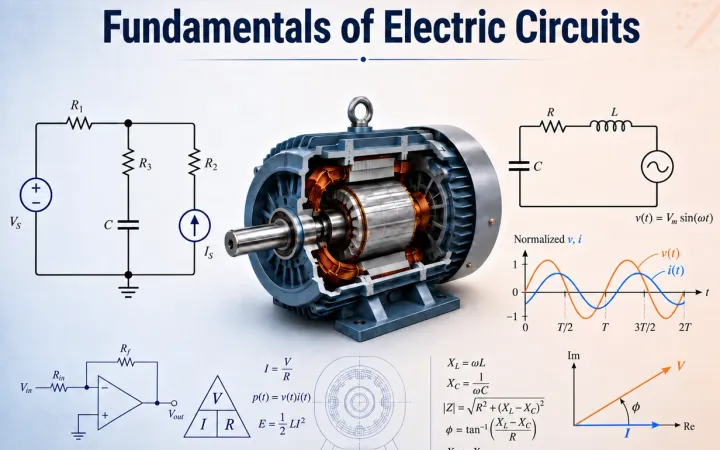
Course Content
ChaptersThe concepts of current, voltage, power and energy, which are the basic quantities of electrical circuits, are discussed in their physical meaning. Resistance, conductivity, independent and dependent sources, passive signal rule and power calculation are examined. In this section, terminal variables of circuit elements, series-parallel connections and basic equivalent resistance calculations are studied with worked examples and problem solving.
How circuit equations are established using Kirchhoff current law and Kirchhoff voltage law is examined. Node voltage method, ambient current method, source transformation and analysis of circuits containing dependent source are handled through worked examples and problem solving. In this section, the relationship between the circuit topology and the mathematical equation system is established.
Superposition in direct current circuits, Thevenin's theorem, Norton's theorem and maximum power transfer theorem are examined. Reduction of complex resistor networks to equivalent circuits, power calculation on the load resistance and source-load relationship worked examples and problem solving are studied. In this section, the purpose of circuit theorems to simplify the solution of engineering problems is emphasized.
Voltage-current relationships, energy storage behavior and initial conditions of capacitor and inductor elements are examined. Electric field energy in the capacitor, magnetic field energy in the inductor and continuity conditions of the circuit variables are discussed. Series-parallel capacitor and inductor equivalents are studied through worked examples and problem solving.
Post-switching transient behavior in first-order RC and RL circuits is examined with a differential equation approach. Natural response, forced response, time constant, initial and final state values are discussed. Charge, discharge, current/voltage change and circuit response worked examples and problem solving in the time domain is studied.
In RLC circuits, the second order differential equation structure is examined through natural frequency, damping ratio and characteristic roots. Overdamped, critically damped and underdamped circuit behaviors are interpreted physically. Transient response, resonance tendency and energy change in series and parallel RLC circuits are addressed by worked examples and problem solving.
Under sinusoidal sources, the circuit response is examined through amplitude, frequency, angular frequency, phase difference and RMS values. Phasor representation, circuit analysis with complex numbers, impedance and admittance concepts are discussed. The AC behavior of resistors, capacitors and inductors is studied through worked examples and problem solving.
In AC circuits, node voltage, ambient current, Thevenin/Norton equivalents and phasor-based solution methods are applied. The concepts of instantaneous power, average power, reactive power, apparent power, power factor and complex power are examined. In series and parallel RLC circuits, resonance, bandwidth and quality factor are considered at a basic level.
Three-phase systems are introduced through the concepts of balanced sources, phase-neutral voltage, line voltage, phase current and line current. Star and delta connections, balanced loads and three-phase power calculation worked examples and problem solving are studied. In this section, the relationship of three-phase circuits with electrical machines and power systems is explained at a basic level.
Within the scope of introduction to semiconductor circuit elements, the basic working principles of diodes and transistors are examined. Ideal and approximate models of the diode, rectifier circuits, clipper and clamper circuits are discussed at a basic level. The idea of switching and amplification for the transistor is interpreted together with the basic usage logic within the circuit.
Operational amplifier circuits are examined based on ideal op-amp assumptions. Virtual short circuit, neglect of input current, negative feedback, inverting and non-inverting amplifier structures are discussed. Basic analyzes of collector, difference amplifier, integrator and differentiator circuits are studied through worked examples and problem solving.
Electrical machines are introduced at a basic level through the principle of conversion between electrical energy and mechanical energy. The concepts of magnetic field, electromagnetic force, induction, transformer logic, DC motor/generator, synchronous and asynchronous machines are introduced. In this chapter, the connection between electrical circuits, magnetic circuits and energy conversion is associated with engineering applications.
Targeted Learning Outcomes
- Physically interpret the concepts of current, voltage, power, energy, resistance, capacitance and inductance.
- Establish node and circuit equations in DC circuits using Kirchhoff's current and voltage laws.
- Simplifying complex circuits with circuit theorems and solving them with the equivalent circuit approach
- Analyze transient regime behavior in RC, RL and RLC circuits with differential equation and time constant approach.
- Perform sinusoidal steady-state analysis in AC circuits by using the concepts of phasor, impedance, reactance and complex power.
- Interpret the ideal and approximate behavior of basic electronic elements such as diodes, transistors and op-amps in the circuit.
- Relate the basic operating principles of electrical machines to the concepts of circuit, magnetic field and energy conversion.