
Calculus II
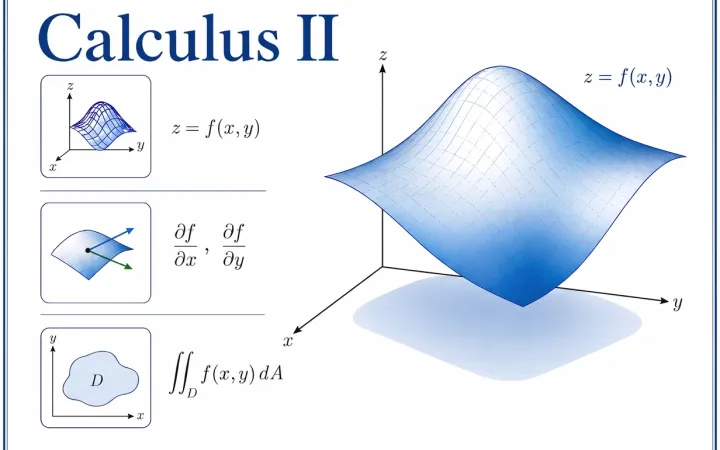
Calculus II is an advanced mathematics course that addresses infinite series, parametric and polar coordinates, space geometry, multivariable derivatives, multiple integrals and integration in vector fields together with geometric interpretation and engineering applications.
Course Content
ChaptersThe concepts of series and infinite series, convergence-divergence behavior and basic convergence tests are discussed. Geometric series, p-series, comparison tests, ratio test, root test, absolute/conditional convergence and alternating series are studied through worked examples and problem solving. Additionally, series expansions of functions are examined through power series, radius of convergence, Taylor and Maclaurin series.
Parametric curves, polar coordinates and different representations of curves are examined. Calculation of speed, tangent slope, curve length and area in parametric equations; Graph drawing in polar coordinates, area calculation and geometric interpretation of curves are studied through worked examples and problem solving.
The concepts of vectors, lines, planes, scalar multiplication, vector multiplication and space geometry in three-dimensional space are discussed. Line and plane equations, distance problems, basic representations of surfaces and three-dimensional geometric interpretation skills are developed through worked examples and problem solving.
Multivariable functions, domains, level curves/surfaces are examined together with the concepts of limit and continuity. Partial derivatives, chain rule, directional derivative, gradient, tangent plane and linear approximation are studied. Additionally, critical points, second derivative testing, multivariate optimization, and Lagrange multipliers are addressed through worked examples and problem solving.
Double and triple integrals. It is examined through area, volume, mass, center of gravity and average value calculations. Establishing integral boundaries and region definition skills in Cartesian, polar, cylindrical and spherical coordinate systems are studied. Coordinate transformations, use of Jacobian and selection of the appropriate coordinate system are addressed through worked examples and problem solving.
Vector fields, line integrals, conservative fields, potential functions and surface integrals are covered. The mathematical and physical meaning of the concepts of circulation, flux, rotational and divergence are examined using Green's Theorem, Stokes' Theorem and Divergence Theorem. These concepts are connected to engineering applications including velocity fields, flow rate, source-sink behavior, and vortices in fluid mechanics, as well as electric and magnetic fields in electromagnetism.
Targeted Learning Outcomes
- Correctly interpreting the concept of convergence in series, infinite series, power series and Taylor expansions
- Use parametric, polar, cylindrical and spherical coordinate systems according to the appropriate problem structure.
- To physically/geometrically interpret the concepts of limit, continuity, partial derivative, gradient and optimization in multivariable functions.
- To develop skills in defining regions in double and triple integrals, establishing integral limits and making coordinate transformations.
- Establish relationships between vector fields, line integrals, surface integrals, Green's, Stokes and Divergence theorems.
- Systematically use Calculus II tools in engineering and basic science problems.