

Calculus I
Calculus 1; concepts of functions, limit, continuity, derivative and integral is a foundational mathematics course that deals with calculation methods, graphic analysis, optimization, area-volume calculations and engineering applications.
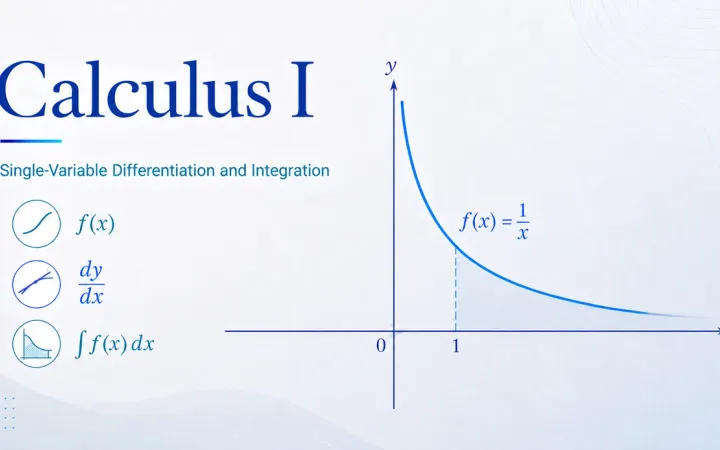
Course Content
ChaptersThe concept of function, domain, value set, graph interpretation and basic function types are discussed. The behavior of polynomial, rational, exponential, logarithmic, trigonometric and piecewise functions is examined. Function transformations, compositional functions, inverse functions and graph reading skills are practiced through worked examples and problem solving.
The concept of limit is examined through the behavior of a function as it approaches a point. Right-left limits, infinite limits, limits at infinity, types of uncertainty and limit taking techniques are discussed through worked examples and problem solving. The concept of continuity, types of discontinuity and limit-function value relationship are interpreted graphically and analytically. Additionally, the behavior of continuous functions on closed intervals and root existence problems are examined through the Intermediate Value Theorem.
The concept of derivative is defined in terms of rate of change and tangent slope. Limit definition of derivative and obtaining derivatives of some basic functions with limit definition, basic derivative rules, chain rule, multiplication-division rules and implicit differentiation methods are studied. Physical and geometric meaning of the derivative. It is associated with the concepts of speed, acceleration, slope and instantaneous change. Additionally, the interpretation of the derivative on function behavior is discussed through Rolle's Theorem and Mean Value Theorem.
By using derivatives, the increase-decrease ranges, critical points, local maximum-minimum values and concavity behavior of the functions are examined. First and second derivative tests, asymptotes and graph drawing worked examples and problem solving are studied. In optimization problems, the emphasis is on establishing the objective function, using constraints, and the physical/engineering interpretation of the result.
The concept of indefinite integral is considered as the inverse of differentiation. Basic integral rules, variable substitution method, piecewise integration, trigonometric integrals and selection of the appropriate integration strategy are studied through worked examples and problem solving. The meaning of the constant of integration and the general family of solutions are interpreted conceptually.
The concept of definite integral is examined through the sum, area and accumulation approach. The idea of the Riemann sum, the meaning of integral limits, and the fundamental theorem of Calculus are discussed. Geometric interpretation of the definite integral, signed area calculation and obtaining physical quantities through integration are studied through worked examples and problem solving.
Using the definite integral, the area under the curves, the region between two curves and volume calculations are examined. Rotational body volumes are calculated using the disk, ring and shell methods. Emphasis is placed on correct establishment of the geometric region, determination of integral limits, and physical/geometric interpretation of the result.
Applications of derivatives and integrals in physics, engineering and geometry problems are discussed. Velocity-acceleration-position relationships, average value, work calculation, accumulation problems and rate of change applications are examined through worked examples and problem solving. In two-dimensional complex geometries, area calculation, center of gravity/centroid determination, area and mass moment of inertia calculations are emphasized. Additionally, rotational surface area and volume problems are studied using the Pappus–Guldinus theorem. In this section, the aim is for the student to transform the mathematical expression into a physical or geometric model.
Generalized integrals that occur over infinite intervals or at points where the integrand is undefined are examined. Concepts of convergence-divergence, integral calculus with limit approach and appropriate comparison ideas are studied through worked examples and problem solving. This section emphasizes not only the calculation of the integral but also the interpretation of whether the result exists or not.
Targeted Learning Outcomes
- To strengthen the mathematical meaning of the concepts of function, limit, continuity, derivative and integral
- Interpret derivative and integral operations not only as formula application but also through the concepts of change and accumulation.
- Choose the appropriate method in graphic analysis, optimization, area, volume and physical application problems.
- Use Calculus tools systematically in engineering and basic science problems.
- Establishing subject integrity before midterm-final, developing formula interpretation and exam-type worked examples and problem solving practice