

Advanced Thermodynamics
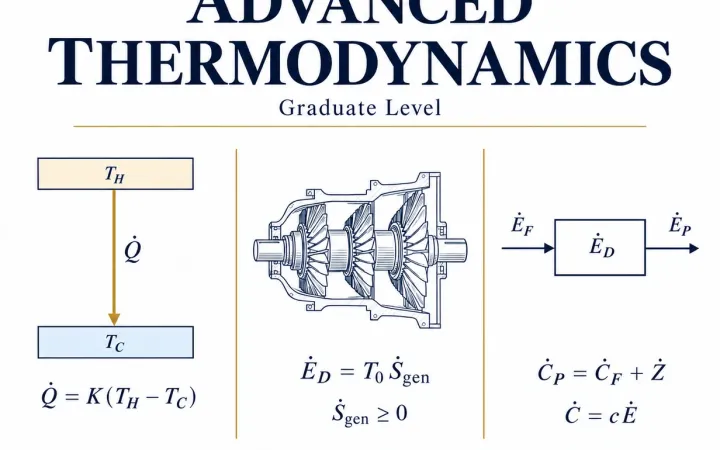
Advanced Thermodynamics is a graduate course that deals with the combined use of the first and second laws of thermodynamics, thermodynamic property relations, entropy-exergy analysis, irreversibility, power and refrigeration systems and finite time thermodynamics at an advanced engineering level.
Course Content
ChaptersThe concepts of thermodynamic system, property, state, equilibrium, process, cycle, reversibility and irreversibility are reconsidered in an advanced framework. Simple compressible systems, equilibrium assumption, quasi-equilibrium processes and thermodynamic modeling approach are examined. In this section, basic concepts at the undergraduate-level are systematized to prepare for the establishment of advanced thermodynamic relations.
The first law of thermodynamics is considered in the form of general energy balance for closed systems and control volumes. The concepts of internal energy, enthalpy, work, heat, flow work and total energy are associated with advanced system analysis. Establishing energy balance in steady-state and transient systems, choosing appropriate assumptions and physical interpretation of energy transitions are studied through worked examples and problem solving.
The second law of thermodynamics is examined through realizability, reversibility, irreversibility and entropy production. Clausius inequality, entropy balance, heat engines, refrigeration systems and Carnot limits are discussed with advanced interpretations. In this section, the difference between energy quantity and energy quality is explained from the second law perspective.
A combined thermodynamic analysis is performed for closed systems and control volumes by using the first and second law together. Reversible processes, entropy balance, energy balance and process direction are evaluated within the framework of the same problem. In this section, it is aimed to interpret thermodynamic processes not only with energy conservation but also with second law limitations.
Differential relations between thermodynamic properties in single-phase systems are derived and interpreted. Quantities such as Maxwell relations, Tds equations, specific heats, compressibility, volumetric expansion coefficient and Joule–Thomson coefficient are discussed. In this section, the systematic calculation of property changes using partial derivatives and thermodynamic potentials is studied.
Power generation systems are examined through energy, entropy and exergy analyses. In steam power cycles, gas turbine cycles and combined cycles, mass, energy and entropy balances are established for the basic elements. The performance of real power systems is interpreted using thermal efficiency, second law efficiency, irreversibilities and exergy destruction.
Refrigeration, heat pump and gas liquefaction systems are considered within the framework of advanced thermodynamic analysis. Vapor compression refrigeration, multistage refrigeration, cascade systems, Joule–Thomson expansion and liquefaction processes are examined from an energy and exergy perspective. Coefficient of performance, second law efficiency and sources of irreversibility are interpreted by worked examples and problem solving.
The irreversible thermodynamics approach is discussed through non-equilibrium processes, fluxes, driving forces, Onsager reciprocity relations and entropy production. Flux-force relationships in heat conduction, diffusion, viscous flow and chemical processes are examined. In this context, coupled transport phenomena and thermoelectric effects. Seebeck, Peltier, Thomson effects and Kelvin relations are studied. Additionally, the concepts of efficiency, COP, figure of merit and optimization in thermoelectric power generation and thermoelectric cooling applications are introduced.
Finite time thermodynamics deals with the difference between ideal reversible cycles and real engineering systems through time constraints and irreversibilities. The relationships between power production, efficiency, heat transfer limitations and cycle time are examined. In this section, instead of maximum efficiency, power-efficiency balance and realistic performance limits in systems operating in finite periods are interpreted.
Energy analysis is discussed through applications of the first law approach in engineering systems. The ability to establish energy balance in closed systems, control volumes, power generation, cooling, heat exchangers and flow systems is developed. In this section, thermodynamic property calculation using EES, equation system solution, parametric analysis and physical interpretation of the results are reinforced with application problems.
Entropy analysis is discussed in terms of second law applications and determination of irreversibility. Entropy balance is established for closed systems and control volumes; Sources of irreversibility such as entropy production, isentropic efficiency, heat transfer and friction are examined. In this section, the feasibility of processes and performance evaluation in terms of the second law are studied through worked examples and problem solving.
Exergy analysis is examined through the concepts of usable energy, environmental state and dead state. Exergy balance is established for closed systems and control volumes; exergy destruction, irreversibility, second law efficiency and loss sources are evaluated. Performance analysis is performed with the exergy approach in power generation, cooling, heat exchangers and flow systems.
Exergy-based thermoeconomics is considered as a special topic that examines the cost impact of losses in engineering systems by combining exergy analysis and economic evaluation approach. The performance of system components is evaluated through the concepts of exergy destruction, irreversibility cost, fuel-product definitions, cost balances, unit exergy cost and exergoeconomic factor. Which components are prioritized for improvement in power generation, cooling, heat exchangers and energy conversion systems, or how to choose among existing components by considering the price-performance balance, are interpreted using thermodynamic and economic perspectives together.
Targeted Learning Outcomes
- Perform advanced system analysis by using the first and second laws of thermodynamics together.
- Derive and interpret thermodynamic property relations, Maxwell relations and property changes in single-phase systems.
- Relate the concepts of entropy production, irreversibility and exergy destruction to the performance analysis of engineering systems.
- Ability to evaluate power generation, cooling and liquefaction systems from energy, entropy and exergy perspectives
- Move from ideal cycles to real system analysis by understanding the basic logic of irreversible thermodynamics and finite time thermodynamics approaches.
- To develop differential relations, modeling and physical interpretation skills in thermodynamics problems at graduate-level.
- Interpret the economic impact of exergy destruction and irreversibility with a thermoeconomic analysis approach.